Happiness at Work
Happiness at Work
The "Holy Grail" of Organizational Productivity
The "Holy Grail" of Organizational Productivity
Happiness at Work: The "Holy Grail" of Organizational Productivity
For decades, employee wellbeing was viewed as an optional HR perk. Modern large-scale economics—including records from over 20 million workers on Indeed—proves wellbeing is a direct driver of financial performance.
As Oxford professor Jan-Emmanuel De Neve and MIT researcher George Ward emphasize, investing in workplace wellbeing is not merely "the right thing to do"—it is high-return business strategy.
Hard Numbers: Why Care?
Field studies and lab experiments establish measurable financial links between employee wellbeing and output:
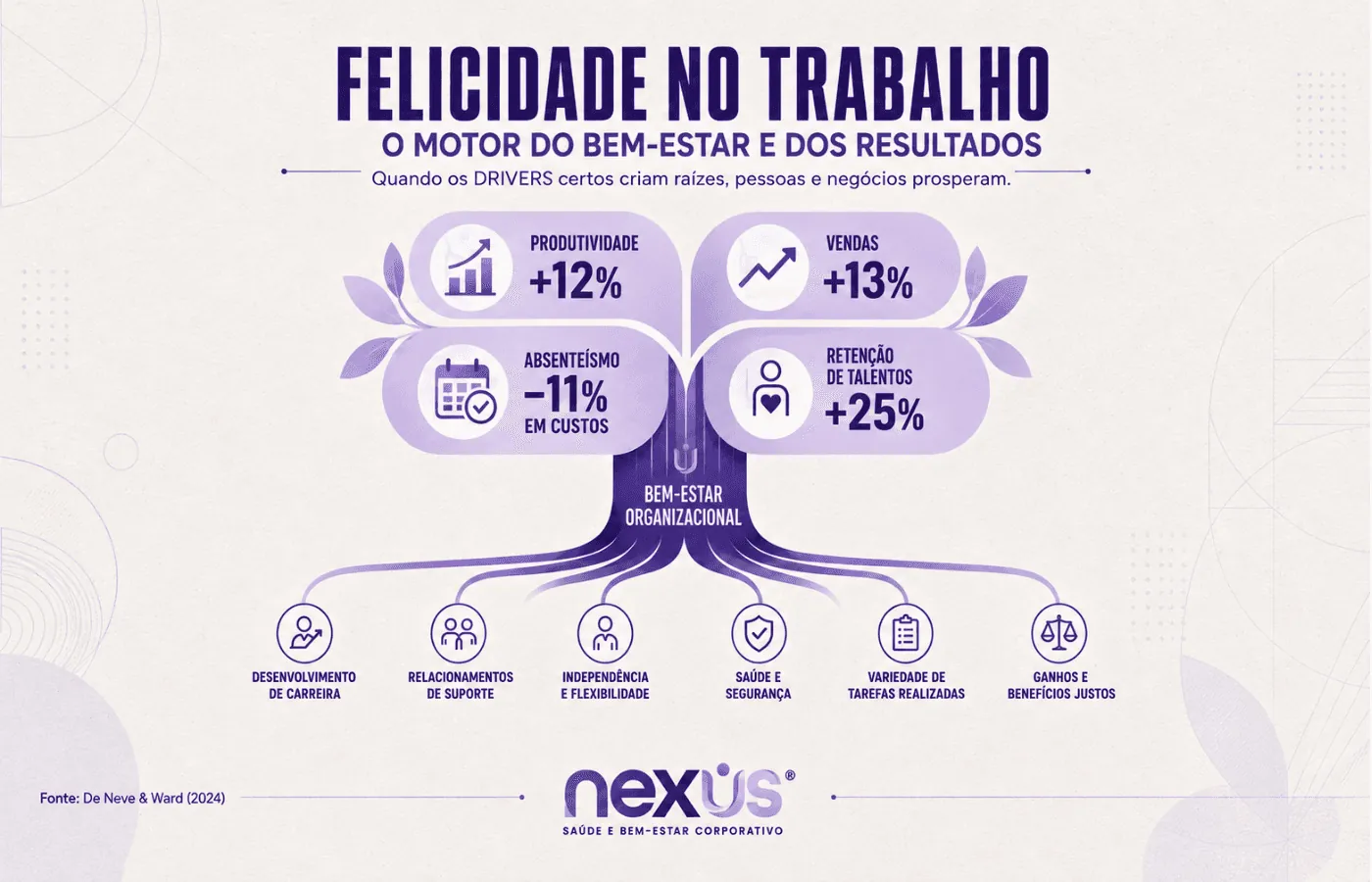
Sales Performance: A landmark study across British Telecom (BT) contact centers showed each one-point rise in weekly happiness drove a 13% increase in sales (Bellet, De Neve & Ward, 2023).
Cognitive Output: Controlled experiments prove positive emotional states raise cognitive productivity by 12% (Oswald, Proto & Sgroi, 2015).
Lower Absenteeism Cost: At a global high-tech manufacturer, low evaluative wellbeing explained 11% of voluntary absenteeism, costing $92 million annually.
Talent Retention: Indeed data demonstrates firms scoring 4 out of 5 in workplace happiness record 25% lower annual turnover than 3-star peers (Ward, 2024).
Core Wellbeing KPIs
To forecast future business performance, researchers track four validated subjective measures used by bodies like the UK Office for National Statistics:
Job Satisfaction: Cognitive role evaluation that reliably predicts turnover risk.
Purpose: Feeling one's daily tasks contribute real social value—closely tied to discretionary effort.
Day-to-Day Happiness: Positive affect directly correlated with weekly operational execution.
Chronic Stress: Elevated stress levels (above 2/5) systematically erode engagement, retention, and mental health.
Management Architecture: The DRIVERs Model
De Neve and Ward highlight that standalone "wellness perks" rarely fix broken workflows. Lasting gains come from strengthening systemic wellbeing DRIVERs:
Development & career security.
Relationships built on trust and leadership support.
Independence & authentic schedule flexibility.
Variety & meaningful achievement.
Earnings & equitable benefits.
Risk management for physical and psychosocial health.
Conclusion
High-wellbeing enterprises consistently outperform market indices and generate higher Return on Assets (ROA). As former Unilever CEO Alan Jope noted: "Look after your people, and they will look after the business."
Does your board measure wellbeing as a strategic financial asset—or merely an HR line expense?